












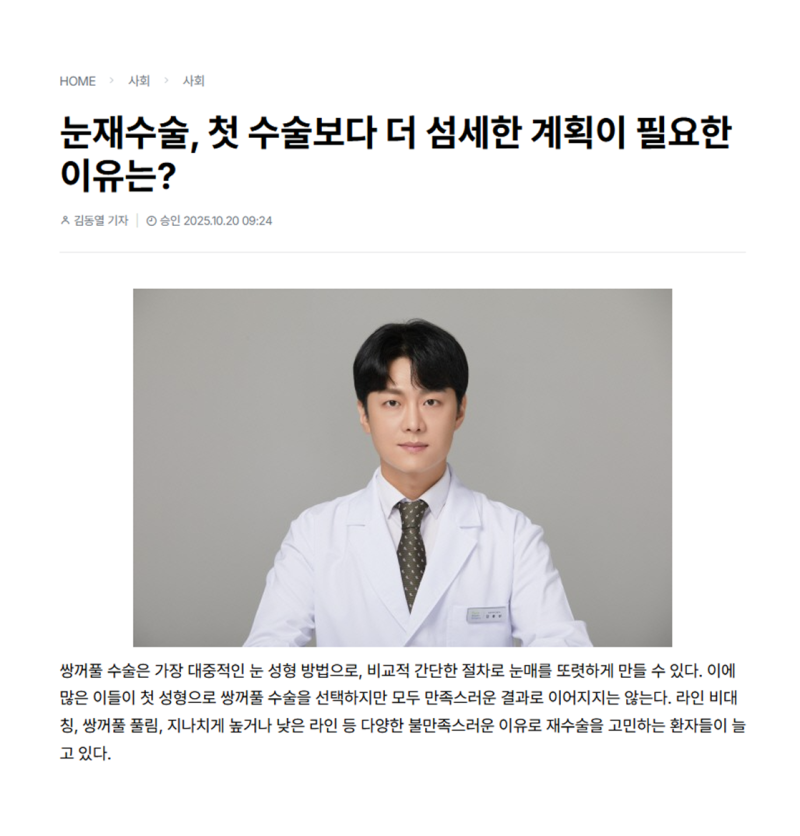
Double eyelid surgery is the most popular eye cosmetic procedure, capable of creating clearer eyes with a relatively simple process. Many people choose double eyelid surgery as their first cosmetic procedure, but not all achieve satisfactory results. An increasing number of patients are considering revision surgery due to various dissatisfactions, such as asymmetrical lines, loosening of the double eyelid, or lines that are too high or too low.
Eye revision surgery is more difficult than the first surgery because it requires not only recreating the double eyelid line but also correcting traces from the previous surgery. The biggest variable in eye revision surgery is the adhesion between the skin, muscle, aponeurosis, and fat layers. Tissues that have adhered during the recovery process of the previous surgery have mixed layers, making it difficult to distinguish normal anatomical boundaries, and increasing the risk of tissue damage or bleeding during revision surgery. Therefore, eye revision surgery should be approached not merely as ‘line restoration’ but as a process of adhesion lysis and tissue reorganization.
Furthermore, if skin or fat was excessively removed in the first surgery, there may not be enough remaining tissue, making double eyelid revision surgery difficult. In particular, the eyelids of Koreans have thin fat layers and delicate skin, so restoration (reinforcement) is more important than unnecessary additional removal. In such cases, an approach is needed to recreate an inter-layer cushioning layer by performing fat grafting, septal insertion, etc., to compensate for the insufficient tissue.
Revision surgery is generally advisable after at least 3 to 6 months have passed since the first surgery. If revision surgery is performed when tissues are not stable, scar tissue can thicken, and the possibility of re-adhesion increases. Therefore, rather than rushing the timing, it is better to perform double eyelid revision surgery when swelling, inflammation, and adhesions have stabilized, allowing for an accurate surgical plan. However, since each patient's recovery speed varies, the timing of revision surgery requires personalized judgment.
When planning revision surgery, it is crucial to accurately identify the cause of the first surgery's failure. The approach layer and revision strategy will differ completely depending on whether the line has loosened, if there was overcorrection, or if there is asymmetry. Satisfactory results can only be achieved by precisely diagnosing the cause of the first surgery's failure and performing customized surgery, rather than simply creating a larger and clearer line than before.
Dr. Kim Hong-jin of 1mm Plastic Surgery stated, ‘Eye revision surgery is an anatomically very delicate process,’ adding, ‘Precise planning and experience are required to safely lyse adhesions of damaged tissue from the first surgery and restore the line.’
He continued, ‘After sufficient consultation with experienced medical staff and based on an accurate diagnosis, personalized surgery must be performed to achieve safe and satisfactory results.’ He emphasized, ‘Especially, an honest judgment that preserves the tissue's potential for recovery is as important as patient satisfaction.’
Source: E-Donga (https://edu.donga.com)
Article link: https://edu.donga.com/news/articleView.html?idxno=96739