












Have you ever looked in the mirror after facial contouring surgery and thought something like this?
My face definitely got smaller… but why does it look bigger over time?
This is a common concern for many people. While some worry that the surgery went wrong, in most cases, the face hasn't actually gotten bigger; rather, it's a change that occurs as sagging begins.
Facial contouring surgery reduces the size and width of the facial bones to improve the overall contour. However, simply reducing the bone size does not mean that soft tissues like skin, fat, and muscles also shrink. The tissues that were previously supported by the bone lose their support, and over time, they begin to descend due to gravity.
These sagging tissues create volume in the lower part of the cheeks and blur the jawline, giving the impression that the face's horizontal width has increased. The actual size of the face hasn't grown; instead, the sagging tissues make the face appear larger. Therefore, this change is not merely a matter of elasticity; restoring the descended tissues to their original position can be an important solution.
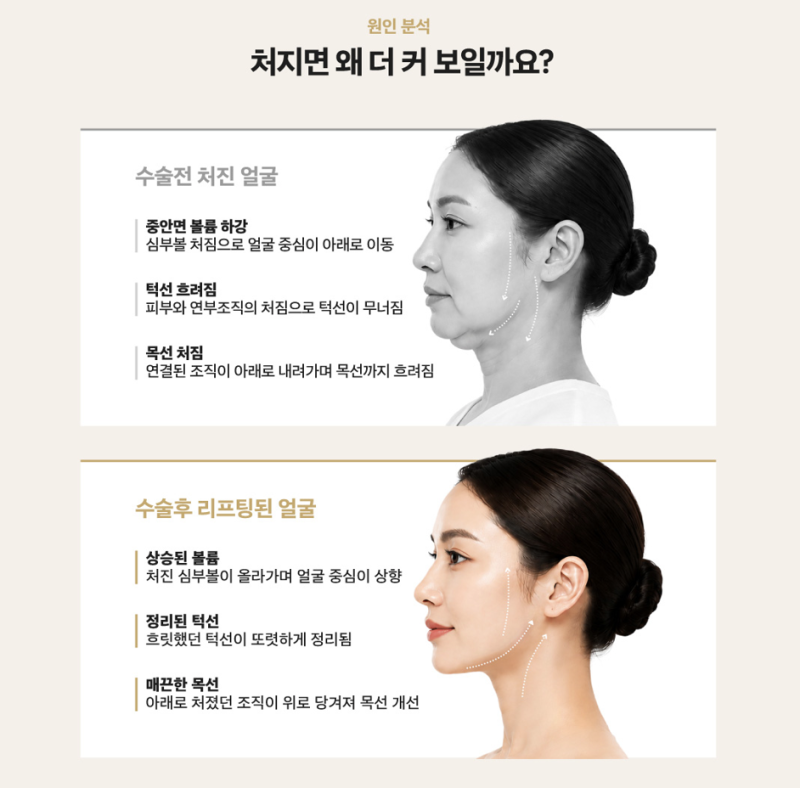
Why does a sagging face look bigger?
The size and impression of a face can vary greatly depending on where the tissues are located. As sagging progresses, the volume in the midface shifts downwards, making the central part of the face appear sunken, while the lower part accumulates cheek fat. If the jawline blurs and the neckline also sags, the boundary between the face and neck becomes ambiguous, giving the impression that the face is much wider and larger than it actually is.
Conversely, when sagging tissues are lifted back to their proper position, the descended volume naturally tidies up, the midface regains its three-dimensionality, and the jawline becomes clearly defined. Furthermore, with a smooth connection to the neckline, the boundary between the face and neck becomes distinct, leading to the effect of an overall smaller and slimmer facial line. Ultimately, what determines the size of the face is not just the size of the bones, but the position of the soft tissues and the clarity of the facial contour. Even simply correcting sagging tissues can significantly change one's impression.
Pre-surgery sagging face
Midface volume descent
Blurred jawline
Sagging neckline
⬇️⬇️
Post-surgery lifted face
Elevated midface volume
Clearly defined jawline
Smoothly connected neckline

Detailed Incisions to Minimize Scar Concerns ✂️
For many considering a mini-lift, the primary concern is scarring. Even if the results are satisfying, a visible incision can be a burden. Facefit Mini-Lift takes this into account, planning customized incisions based on each individual's condition. However, incision length is not the only important factor.
The key is to meticulously analyze the natural curve of the ear and the direction of the hairline to design the incision location, ensuring the scar can be concealed as naturally as possible. Additionally, unnecessary wide dissection is minimized to reduce tissue damage, and the suturing process is carefully considered to prevent excessive tension on the skin. These details not only reduce the burden of scar exposure but can also positively impact the recovery process. Ultimately, the perfection of a mini-lift depends less on how small the incision is, and more on how precisely it is designed and how naturally it is finished.
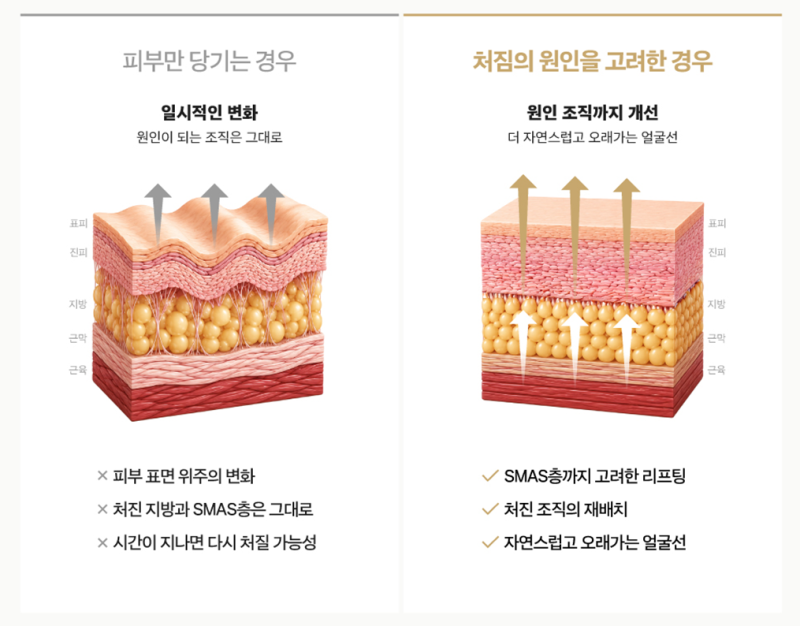
Focusing on the Cause of Sagging, Not Just Visible Sagging ✧
Simply pulling up sagging skin might show significant changes initially, but there's a possibility of it sagging again over time.
Therefore, for longer-lasting results, it's crucial to consider not only the visible skin but also the deeper layers that cause the sagging. The Facefit Mini-Lift at 1mm Plastic Surgery focuses on anatomically repositioning the sagging tissues, taking into account the SMAS layer located beneath the skin.
The SMAS layer is a crucial structure that supports the face, and lifting this layer along with the skin can lead to more natural and stable results compared to just pulling the skin. The key is not merely to create temporary changes by tightening, but to improve the cause of sagging and maintain a natural facial line over time.
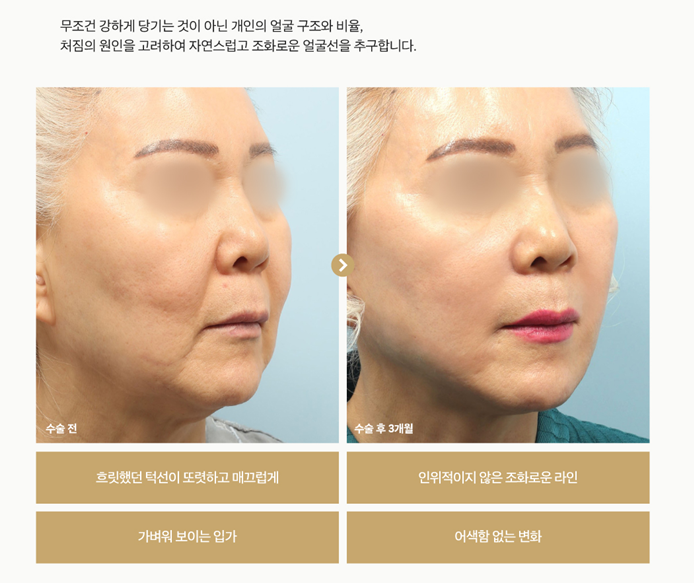
Natural Facial Lines, Not Over-Tightening
More pulling does not necessarily lead to better lifting results. On the contrary, if the skin is pulled too tightly, the face can look unnatural or expressions might appear awkward. The important thing is to naturally restore the sagging tissues to their original position, thereby regaining the face's inherent balance.
The Facefit Mini-Lift does not simply pull upwards; instead, it performs the lift in a natural direction, considering facial movements and skin tension. As a result, the blurred jawline becomes more defined, and the mouth area, which previously looked heavy due to sagging, can achieve a lighter impression. The goal is not for someone to say, ‘You had surgery,’ but rather, ‘Your face looks great these days,’ or ‘You look younger.’ This is the direction a natural lift should pursue.

Ultimately, what matters is not how much you pull,
but how you pull 💫
When considering a mini-lift, many people focus on the size of the incision or how strongly the skin is pulled. However, what determines long-lasting, satisfying results is not simply the technique of pulling a lot, but how it is pulled. Only by accurately analyzing the cause of sagging and repositioning the lax tissues according to their anatomical structure can natural facial lines be created.
Furthermore, lifting should consider not only tightening the skin but also the SMAS layer to achieve relatively stable results over time. The Facefit Mini-Lift focuses on restoring the face's inherent balance and lines, rather than forcibly pulling up sagging tissues. Ultimately, a good lift is not about a noticeable change, but about a change that maintains a natural and comfortable impression over time.
It's not about changing the face, but about restoring its original lines.
That is the standard of lifting pursued by Facefit Mini-Lift ⭐

When visiting, please use the parking lot at
‘Apro Square’ located diagonally behind 1mm Plastic Surgery.
Parking Lot Name: Apro Square
Address: 55 Seocho-daero 77-gil, Seocho-gu, Seoul